What to Do When Your Chinese Supplier Disappears After Payment
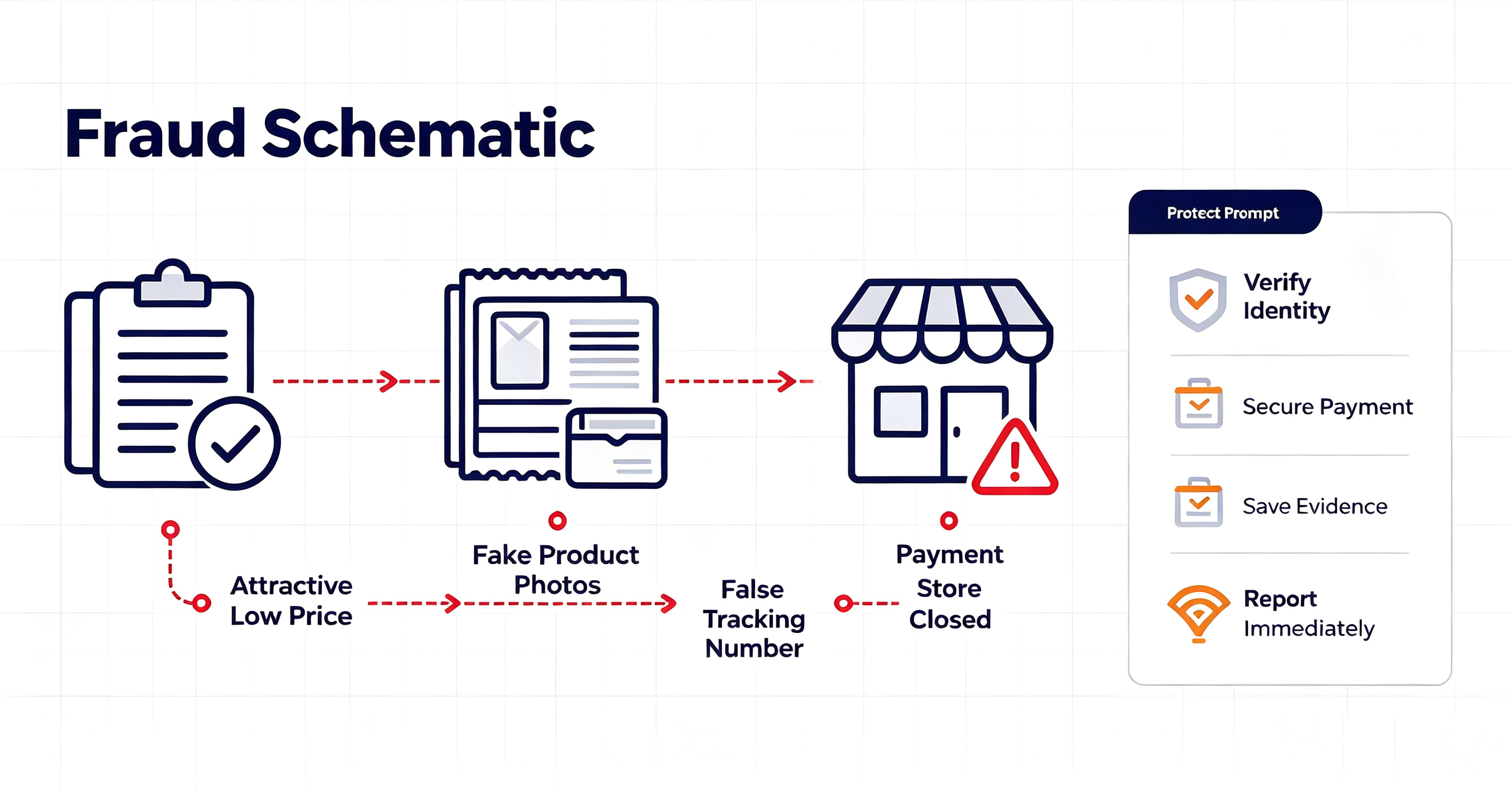
This is the scenario every foreign buyer dreads: you found a supplier on Alibaba.com, negotiated terms, paid the invoice—and then the supplier disappeared. The store page shows “no longer available.” Messages go unanswered. The goods never arrived, or what arrived was worthless. This article explains why this happens, what immediate steps to take, and what legal remedies are available to foreign buyers under Chinese law.
This article explains why this happens, what immediate steps to take, and what legal remedies are available to foreign buyers under Chinese law.
How the Trap Works: The Auto-Confirm Pattern
The typical scam on Chinese wholesale platforms follows a predictable pattern:
- The supplier takes your order, often at a price noticeably below market, and provides a professional-looking Proforma Invoice or even a formal contract.
- They mark the order as "shipped" using a self-arranged logistics method (not a trackable carrier). A fake tracking number may be provided, or no tracking at all.
- The platform auto-confirms receipt. On many platforms, if the buyer does not manually extend the receipt period or raise a dispute, the system automatically confirms delivery after a set number of days (historically as short as 10 days on some platforms, though Alibaba.com has extended this to 30 days for self-arranged shipments since November 2022). Once confirmed, the payment is released to the supplier.
- The store disappears. The supplier closes the shop or the platform shuts it down after receiving complaints—but by then, the money is gone.
- The platform says it cannot refund you because the supplier had no security deposit (保证金) frozen on the platform, and the platform has no legal authority to seize funds from the supplier's bank account.
The Trade Assurance Coverage Problem
On Alibaba.com, Trade Assurance provides a layer of buyer protection—but it is not a guarantee. Coverage depends on the supplier's credit limit with the platform. A supplier with a low Trade Assurance limit relative to your order value leaves a gap: only a portion of your payment may be covered. A fraudulent supplier may accept large orders, ship nothing, and disappear—leaving you with only partial coverage. Some suppliers also operate with minimal platform history, no Trade Assurance badge, or recently created accounts. These suppliers have little to lose from a platform ban.
On Alibaba.com (the international platform), Trade Assurance provides a layer of protection—but only up to the supplier's coverage limit. A supplier with a low Trade Assurance limit relative to your order value leaves a gap. Before placing any large order, check the supplier's Trade Assurance coverage amount and verify that it covers your full payment.
Immediate Steps to Take
1. Preserve All Evidence Immediately
Before the store page disappears completely or the supplier deletes records:
- Screenshot the product listing, supplier company profile, Trade Assurance details, and all chat messages.
- Save the Proforma Invoice, Purchase Order, and contract in PDF format.
- Download bank transfer records showing the payment amount, date, beneficiary name, and account number.
- Record the supplier's registered company name (often different from the store name). Look for the company name in the Proforma Invoice header, bank account beneficiary name, or on the supplier's Alibaba profile page under "Company Profile" → "Business License."
2. File a Dispute on the Platform
Even if the platform's initial response is "we cannot refund," file a formal dispute immediately. The dispute creates a record. If the supplier later reappears or the platform's fraud protection mechanisms engage, having a timely dispute on file strengthens your position.
3. Verify the Supplier's Real Identity
Many buyers do not actually know who they paid. The store name ("Best Electronics Co.") may be different from the legal entity that received your money. Check:
- The bank account beneficiary name. Does it match the company on the contract?
- Whether the supplier used an offshore account. Some Chinese suppliers route payments through Hong Kong or other offshore accounts, making it harder to link the payment to a mainland Chinese entity.
- Whether the legal entity actually exists. A Chinese lawyer can search the National Enterprise Credit Information Publicity System to confirm the company's registration status, registered capital, legal representative, and whether it has a history of lawsuits or administrative penalties.
4. Report to the Platform's Fraud Team
Beyond the standard dispute process, escalate to the platform's fraud or trust and safety team. Provide evidence that the supplier engaged in intentional fraud (not merely a contract dispute). Alibaba has cooperated with police in major fraud cases and, since late 2022, has extended auto-confirmation periods and strengthened store verification in response to this issue.
5. Consider a Police Report in China
If the amount is substantial and there is evidence of intentional fraud (rather than a civil contract dispute), you can report the matter to the Chinese Public Security Bureau (PSB). In practice:
- Police are more likely to accept a case if the foreign buyer comes to China in person to file the report, rather than reporting through a representative.
- A police report is more effective when accompanied by a well-organised evidence package in Chinese, including payment records, correspondence, and proof that the supplier never intended to deliver.
- Where goods were partially shipped or the supplier made some effort to perform, police will often treat the matter as a civil dispute and decline to open a criminal case.
Legal Action in Chinese Courts
If the platform cannot help and the police decline to intervene, a civil lawsuit in a Chinese court may be the only path to recovery. Chinese law provides strong remedies for breach of contract:
- Full refund of the purchase price plus interest from the date of payment (CISG Article 84; PRC Civil Code).
- Compensation for foreseeable losses, including lost profits on resale contracts (CISG Article 74; PRC Civil Code Article 584).
- Property preservation (asset freezing): If you can identify the supplier's bank account or assets in China, a court can freeze those assets at the start of the lawsuit to prevent dissipation.
- Shareholder liability: For one-person limited liability companies, the sole shareholder is personally liable for company debts unless they can prove their personal assets are separate from company assets. This is a powerful tool against shell companies.
A 2023 case from Shenzhen Intermediate Court illustrates the point: an Italian buyer paid a Shenzhen company US$250,000 for gloves that were never delivered. The supplier refunded approximately US$147,000 but kept the remaining US$103,000. The court ordered full refund of the balance plus interest at 3.85% per annum from the date of partial refund, and held the company's sole shareholder jointly and severally liable because he could not prove separation of personal and corporate assets ((2023) Yue 03 Min Zhong No. 36761).
For more on the legal framework, see Recover losses from China suppliers: a 4-step guide and Foreign judgments & arbitral awards in China.
This article is general information only, not legal advice for your matter. For professional assistance, consult a PRC-licensed lawyer at Zhang&Partners.